
Organizational Performance Framework
The Conquer The Success Corporates
Organizational Diagnostics Framework – A 6-8 Months Journey
What Organizational Performance Framework Is ?
Conquer the Success for Corporates is a structured, time-bound engagement model (typically 6-8 months) desiged to:
- Diagnose performance gaps at strategy, proces, and people levels.
- Implement evidence-based, Six Sigma inspired changed.
- Embed sustainability through policies, reviews and continual improvement.
Who This Framework Helps
Conquer The Success for Corporates transforms organizations in two scenarios:
-
Comprehensive turnaround: Where strategy, processes, and people’s emotional health need strengthening—using our full 5-phase DMAIC journey.
-
People-focused boost: Where strategy and processes are already strong, but employees underperform due to stress, unhappiness, or personal/professional challenges. We zero in on emotional well-being, targeted coaching, and happiness interventions for rapid productivity gains (backed by research showing 12–13% uplift in happier teams).
The Structured Implementation Cycle – The 5- Phase Organizational Diagnostics Framework (DMAIC)
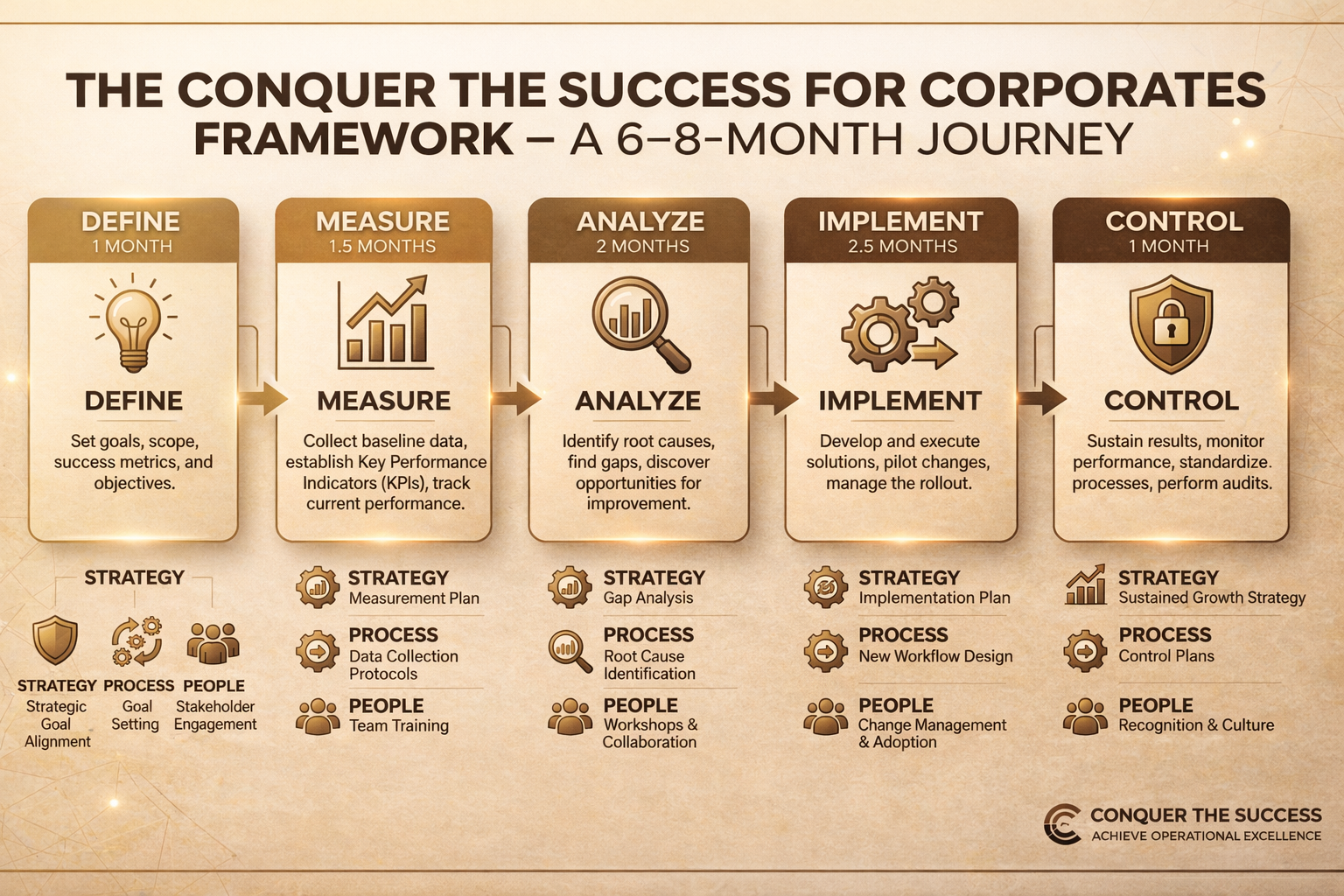
The framework follows a structured improvement journey inspired by the Six Sigma DMAIC methodology (Define – Measure – Analyse – Implement – Control), adapted specifically for organizational transformation.
1. DEFINE PHASE – Understanding The Need (Week 1-4: 1 month)
-
STEP- 1: Interviews with CXOs / Business Owners
- Understand challenges, risks, 3‑year ambitions, and ROI expectations.
-
STEP -2: Organizational Diagnostics
- Assess strategy, planning, leadership, culture, and people systems.
-
STEP – 3: Customized Improvement Plan
- Build a tailor‑made roadmap for improvement.
- Present and approve it in a formal gate review with leadership.
2. MEASURE PHASE – Collecting the Data (Week 5 -10: 1.5 months)
-
STEP – 4: Process Mapping & Assessment
- Evaluate process health, clarity, and effectiveness across key functions.
-
STEP – 5: Strategic & Planning Review
- Analyze mission, vision, long‑term and short‑term plans, dashboards, KPIs, and review mechanisms.
-
STEP – 6: Employee Well‑being & Happiness Measurements
- Use psychometric tools, work‑life‑balance assessments, and stress indicators to gauge emotional health and happiness—aligned with research showing 12–13% higher productivity in happier employees.
-
STEP – 7: Identify Underperformers
- Work with HR and line managers to shortlist individuals whose performance is below potential.
All data is consolidated into a comprehensive baseline report and presented in a second gate review with leadership.
3. ANALYZE PHASE – Root Cause (Week 11-18: 2 months)
-
STEP – 8: Root‑cause analysis of performance gaps across:
- Strategy & planning
- Processes & systems
- People & culture
-
STEP – 9: Clearly link low performance to whether it arises from:
- Flawed processes.
- Poor planning and review.
- Unhappiness, emotional health issues, or relationship conflicts.
-
STEP – 10: Prepare a prioritized improvement‑action list with expected business impact
- Productivity
- Engagement
- Profitability
-
STEP – 11: Executive Gate Review
- A detailed analysis report is presented to leadership for approval before implementation begins.
4. IMPLEMENT PHASE – Action & Transformation (Week 19-28: 2.5 months)
-
STEP – 12: Execute prioritized actions
- Roll out process optimizations, strategic realignments, and leadership interventions.
-
STEP – 13: Targeted coaching and training
- Focus on underperformers and key teams to build emotional intelligence, resilience, and high-performance habits.
-
STEP – 14: Well-being initiatives
- Introduce stress-reduction programs, conflict resolution workshops, and happiness-boosting policies (e.g., flexible work, recognition systems).
-
STEP – 15: Monitor early wins
- Track quick improvements in KPIs and employee feedback via pulse surveys.
-
STEP – 16: Executive Gate Review
- To validate progress and adjust the roadmap.
5. CONTROL PHASE – Embedding Sustainability (Week 29-32 : 1 month)
-
STEP – 17: Develop sustaining mechanisms
- Create updated policies, dashboards, and review cadences for ongoing monitoring.
-
STEP – 18: Build internal capabilities
- Train in-house champions on diagnostics, root-cause tools, and well-being metrics.
-
STEP – 19: Long-term reinforcement
- Establish annual health checks and continuous improvement cycles.
-
STEP – 20: Final impact report
- Quantify ROI (e.g., productivity gains, turnover reduction) and celebrate transformation.
-
STEP – 21: Handover
- Leadership sign-off, ensuring self-sustaining growth.